Introduction: The OEM vs ODM Decision Every Period Panties Brand Must Make
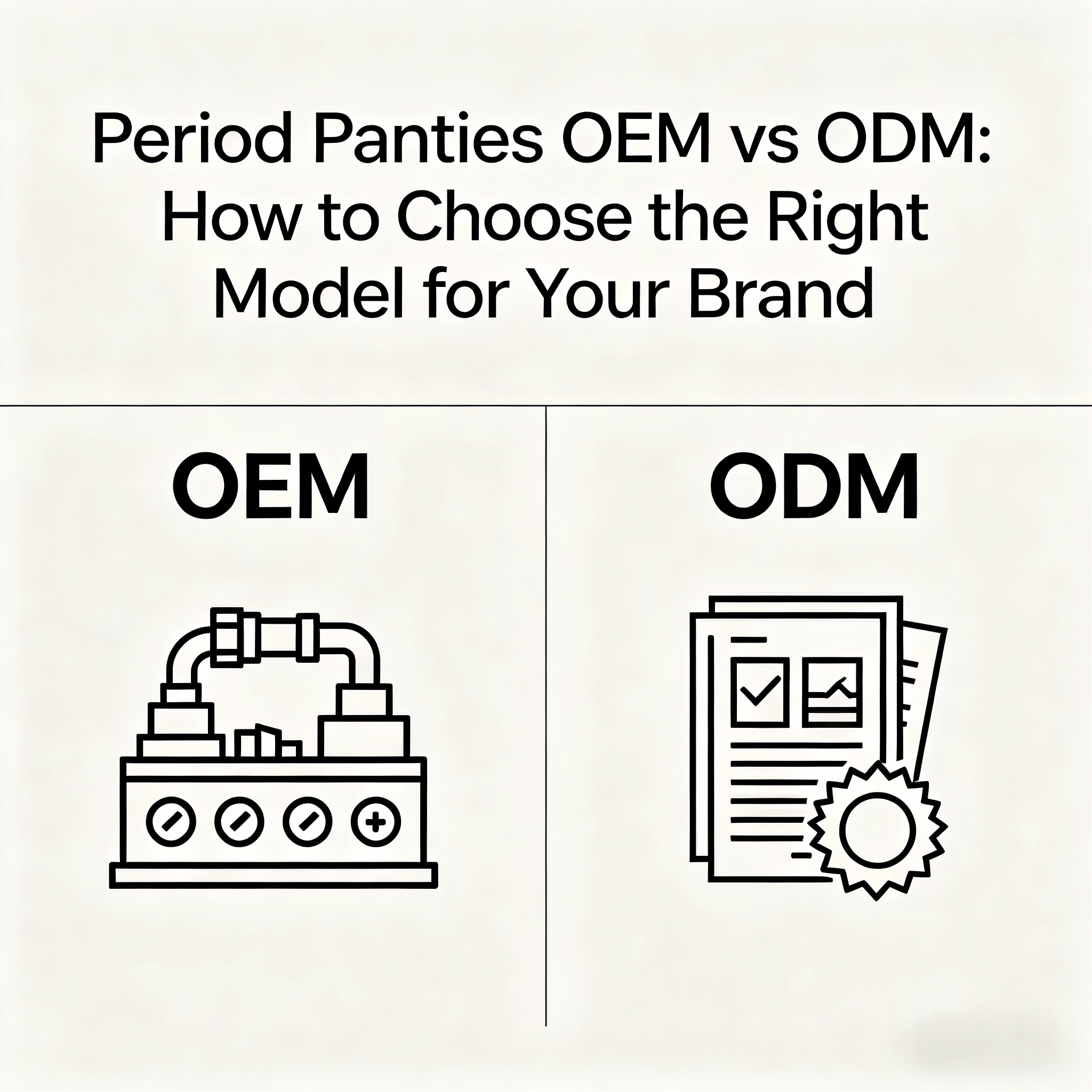
When you decide to launch or expand a period panties brand, one of the first — and most consequential — decisions you will face is whether to go OEM or ODM with your manufacturing partner. The choice between period panties OEM vs ODM affects your development timeline, upfront costs, degree of product differentiation, and long-term brand positioning.
Both models are legitimate, proven routes to market for period underwear brands. The right choice depends entirely on your specific situation — your budget, your design capabilities, your timeline, and where your brand is in its development journey. In this guide, Jingzhihe breaks down both models in detail, compares them side by side, and helps you make the decision that is right for your brand.
What Is OEM Period Panties Manufacturing?
OEM stands for Original Equipment Manufacturing. In an OEM arrangement for period panties, you — the brand owner — provide the design specifications, technical requirements, and branding details, and the factory manufactures the product exactly according to your instructions. You own the design, the intellectual property, and the product identity entirely.
How OEM Works in Practice
In a typical OEM period panties project, the process begins with you supplying a technical design pack (TDP) or detailed product brief to the factory. This brief specifies every aspect of the product: the style and cut, the fabric composition for each layer, the absorbency level, the sizing, the colorways, and the branding details including label, packaging, and hang tag design.
The factory’s role is to translate your specifications into a physical product — developing the pattern, sourcing the specified fabrics, producing samples for your approval, and then manufacturing in bulk once you sign off on the pre-production sample. The factory does not contribute design input; they execute your vision with their manufacturing expertise.
When OEM Is the Right Choice
You have a clear and detailed product concept with specific design requirements that differentiate your brand.
You have internal design resources — a product developer, designer, or technical team — who can create or manage technical design packs.
Brand differentiation and product uniqueness are strategic priorities — you need a product that is genuinely yours.
You are scaling an existing product that has proven market demand and you want to maintain full control over specifications.
Long-term intellectual property ownership is important to your business model.
OEM Advantages and Limitations
Advantage: Maximum product differentiation — your design is unique to your brand.
Advantage: Full control over every material, construction detail, and performance specification.
Advantage: You own the design IP — protecting your product from copying.
Limitation: Longer development timeline — pattern development, sampling, and revisions take time.
Limitation: Higher development cost — you pay for the design development process.
Limitation: Requires design expertise on your side to create or manage technical specifications.
What Is ODM Period Panties Manufacturing?
ODM stands for Original Design Manufacturing. In an ODM arrangement, the factory already has existing period panties designs — developed and owned by them — that you can select, customize, and brand as your own. You are essentially licensing the factory’s design and adapting it to your brand’s requirements, rather than creating a new design from scratch.
How ODM Works in Practice
In a typical ODM period panties project, you browse the factory’s existing product catalog or sample library and select styles that align with your brand vision. You then customize the chosen styles within the factory’s available options — typically covering fabric choice, color, size range, absorbency level, and branding details such as labels and packaging.
Because the base design already exists, the development process is much faster than OEM. The factory can produce branded samples quickly, often within one to two weeks, and bulk production timelines are typically shorter. The trade-off is that your product shares its base design with any other brand that chooses the same ODM style — limiting the exclusivity of your product in the market.
When ODM Is the Right Choice
You are launching your first period panties product and want to reach market quickly with manageable upfront investment.
Your brand is in the early stages and you want to test consumer demand before committing to full design development.
Your internal team does not have product development or technical design expertise.
Budget is a primary constraint — ODM minimizes development costs significantly.
You are an individual entrepreneur, a small team, or a DTC startup entering the period underwear category for the first time.
ODM Advantages and Limitations
Advantage: Faster time to market — no lengthy design development process.
Advantage: Lower development cost — the design investment has already been made by the factory.
Advantage: Lower MOQ — less setup complexity means factories can offer smaller minimum orders.
Advantage: Access to the factory’s proven designs — products that are already known to perform well.
Limitation: Limited exclusivity — other brands may use the same base design.
Limitation: Less differentiation — your product identity is constrained by the factory’s existing design range.
Limitation: The factory retains IP ownership of the base design.
OEM vs ODM: Side-by-Side Comparison
Here is a direct comparison of both manufacturing models across the key decision factors:
Factor | OEM — You Design | ODM — Factory Designs |
Product Design | Fully your own design and specs | Factory’s existing design, adapted |
Brand Differentiation | Maximum — unique to your brand | Moderate — shared base design |
Time to Market | Longer (4–12 weeks for development) | Faster (1–3 weeks to sample) |
Development Cost | Higher — patterns, samples, revisions | Lower — design already exists |
MOQ | Often higher per style | Lower — less setup required |
Design Expertise Needed | High — you drive the brief | Low — factory guides you |
Customization Depth | Full — every detail is your choice | Partial — within factory’s range |
IP Ownership | You own the design | Factory retains base design |
Best For | Established brands, unique products | New brands, fast market entry |
Risk Level | Higher upfront investment | Lower entry risk |
The Hybrid Approach: Starting ODM, Moving to OEM
Many successful period panties brands follow a hybrid path — starting with ODM to enter the market quickly and test demand, then transitioning to full OEM once they have validated their product-market fit and built the internal resources to manage design development.
This approach makes excellent commercial sense. ODM provides a fast, low-risk route to your first product, generates early revenue, and gives you real consumer feedback that informs your OEM design development. Once you know what your customers love about your initial product — and what they wish were different — you can develop a fully custom OEM product that precisely meets those needs.
At Jingzhihe, we actively support clients through this transition. We work with many brands that started with our ODM styles and have since developed their own unique OEM designs with our manufacturing support.
Decision Guide: Which Model Is Right for Your Brand?
Use the following quick-reference guide to identify the right manufacturing model for your current situation:
Your Situation | Choose OEM | Choose ODM |
You are launching your first period panties product | | ✅ |
You have a clear design vision and technical design pack | ✅ | |
You want to reach market as fast as possible | | ✅ |
You need maximum brand differentiation | ✅ | |
Your budget for development is limited | | ✅ |
You are scaling an existing successful product | ✅ | |
You want to test demand before a full brand launch | | ✅ |
You have a dedicated product development team in-house | ✅ | |
You are an individual entrepreneur or small team | | ✅ |
Long-term IP ownership is a priority for your brand | ✅ | |
What Jingzhihe Offers for Both OEM and ODM Period Panties
As a specialist period underwear factory in China, Jingzhihe is fully equipped to support both OEM and ODM clients — and to guide brands through the decision-making process based on their specific needs and goals.
Our OEM Capabilities
Full design development support from technical brief to production-ready pattern
Fabric sourcing across all functional layers — organic cotton, bamboo, modal, TPU, nylon-spandex, and more
Custom sizing grading from XS to 6XL including extended sizes
Complete private label branding: labels, hang tags, and custom packaging
Pre-production sample development within 7–14 business days
Bulk production with documented QC at every stage
Our ODM Capabilities
Extensive library of proven period panties styles across all cuts and absorbency levels
Rapid sample production — branded ODM samples typically within 7–10 business days
Flexible customization within our ODM range: fabric, color, size, absorbency, and branding
Low MOQ options — ideal for new brands and market testing
Fast bulk production timelines — typically 20–30 business days after sample approval
Start Your Period Panties Brand with Jingzhihe — OEM or ODM
Whether you are launching your first period panties collection via ODM or developing a fully custom OEM product line, Jingzhihe has the expertise, flexibility, and commitment to quality to be the right manufacturing partner for your brand. Our team will help you evaluate the right model for your situation and guide you through every step of the development and production process.
Contact Jingzhihe today:
Website: https://ysssecret.com/
Email: susie@ysslingerie.com
Phone / WhatsApp: +86 13242263626
We look forward to helping you build a period panties brand that stands out — whichever manufacturing path you choose.