Introduction: The Surprisingly Recent History of Period Panties
The history of period panties is shorter than most people expect — and more transformative than almost any other product in the menstrual health category. What began as an obscure, impractical novelty product just two decades ago has become a multi-hundred-million-dollar global market, stocked in pharmacies, department stores, and online retailers worldwide. The rise of period panties is not just a product story — it is a story about shifting consumer values, technological innovation, and the growing conversation around menstrual health and sustainability.
In this article, we trace the complete history of period panties from the earliest prototypes to the sophisticated, globally manufactured product they are today — exploring the milestones, the breakthroughs, and the cultural shifts that turned a niche idea into a mainstream menstrual revolution.
Before Period Panties: The Long History of Improvised Menstrual Protection
To understand the history of period panties, it helps to understand what came before them. For most of human history, menstruating people improvised their own protection using whatever materials were available — rags, wool, moss, and other absorbent natural materials. The term “on the rag” is a direct linguistic remnant of this era.
The first commercially manufactured menstrual products appeared in the late 19th and early 20th centuries. Disposable pads became commercially available in the 1890s, developed from the cellulose bandage materials used by nurses during World War I. Tampons followed in the 1930s, with the Tampax brand launching in 1936. For the next eight decades, disposable pads and tampons dominated the menstrual products market almost entirely — until a new generation of consumers began asking different questions.
The Seeds of Change: Growing Dissatisfaction with Disposables
By the 2000s, a combination of factors was beginning to create the conditions for a period underwear revolution. Environmental awareness was growing, and consumers were becoming increasingly conscious of the waste generated by single-use menstrual products. Health-conscious consumers were also raising questions about the chemical content of conventional pads and tampons — including bleaching agents, synthetic fragrances, and pesticide residues in non-organic cotton.
At the same time, the rise of e-commerce was creating new pathways for niche and innovative products to reach consumers directly, without the need for traditional retail distribution. These converging forces — sustainability consciousness, health awareness, and digital commerce — would together create the foundation for the history of period panties as a commercially viable product category.
The Early History of Period Panties: First Prototypes and Pioneers
The Pre-Commercial Era (Pre-2010)
The earliest versions of what we might recognise as period panties were far removed from the comfortable, high-performance products available today. Early prototypes — developed by individual inventors and small companies in the 2000s — were typically heavy, uncomfortable, and unreliable. They often consisted of thick rubber or plastic-coated underwear designed primarily as backup protection against pad or tampon failure, rather than as standalone menstrual products.
These early iterations failed to find a significant consumer audience. The construction was too bulky, the materials were too uncomfortable for extended wear, and the products were not widely available or marketed. However, they planted the seed of an idea that would be dramatically refined in the decade that followed.
The Pioneer Brands (2011–2014)
The modern history of period panties effectively begins in the early 2010s, when a handful of entrepreneurial brands began developing genuinely wearable, multi-layer period underwear using advances in textile technology. In the United States and Australia, small companies began experimenting with combinations of moisture-wicking fabrics, technical absorbent materials, and thin waterproof barrier layers that could be built into a garment slim enough to wear like regular underwear.
These pioneer brands faced significant challenges. Consumer awareness of the product category was virtually zero. Retail channels were closed to an untested product in a category that did not yet formally exist. Manufacturing options were limited — most garment factories had no experience with the technical multi-layer construction required. The earliest products were expensive to produce, available in limited quantities, and sold almost exclusively online to a small audience of early adopters willing to invest in a new concept.
The Breakthrough Years: Crowdfunding and Consumer Validation (2014–2016)
The turning point in the history of period panties came with the rise of crowdfunding platforms, particularly Kickstarter and Indiegogo. Between 2014 and 2016, several period underwear brands launched crowdfunding campaigns that generated significant attention and funding — and, crucially, proved to a wider audience that real consumer demand existed for the product.
These campaigns did more than raise money. They generated media coverage, social media discussion, and a first wave of genuine consumer reviews from backers who had tried the product. The combination of positive reviews, sustainability credentials, and the novelty of the concept attracted the attention of mainstream media. Articles began appearing in major publications in the US, UK, and Australia — dramatically accelerating public awareness of period panties as a concept.
This era also saw the first serious investment in the category, with venture capital beginning to flow into period underwear brands that had demonstrated consumer validation through their crowdfunding success.
Mainstream Adoption: The Retail Expansion Era (2017–2020)
By 2017 and 2018, the history of period panties had entered a new phase: mainstream retail. Major department stores in the US, UK, and Australia began stocking period underwear for the first time. E-commerce platforms including Amazon added the category. Established pharmaceutical retailers began listing period panties alongside conventional menstrual products — a symbolic moment that marked the product’s transition from niche alternative to legitimate menstrual health option.
During this period, the number of brands competing in the category multiplied rapidly. The success of pioneer brands attracted new entrants, and the growing competitive landscape drove rapid product improvement. Absorbency levels increased. Styles diversified from a handful of basic cuts to a full range of bikinis, boyshorts, hipsters, thongs, and overnight styles. Size ranges expanded to be more inclusive. Sustainable material options — organic cotton, bamboo, recycled fabrics — became widely available as consumer demand for eco-friendly credentials grew.
The Pandemic Acceleration (2020–2021)
The COVID-19 pandemic of 2020 and 2021 had an unexpected but significant impact on the history of period panties. Supply chain disruptions affected the availability of conventional disposable menstrual products in some markets, prompting consumers to explore reusable alternatives for the first time. At the same time, the pandemic broadly accelerated consumer interest in sustainability and health-conscious purchasing — trends that aligned perfectly with the period underwear value proposition.
Period panties sales grew significantly during this period. New consumers who might otherwise have taken years to try period underwear were pushed to consider alternatives more quickly. Many of those who tried period panties during the pandemic became long-term converts, contributing to a sustained step-change in adoption rates.
The Global Scale-Up: Manufacturing Comes of Age (2022–Present)
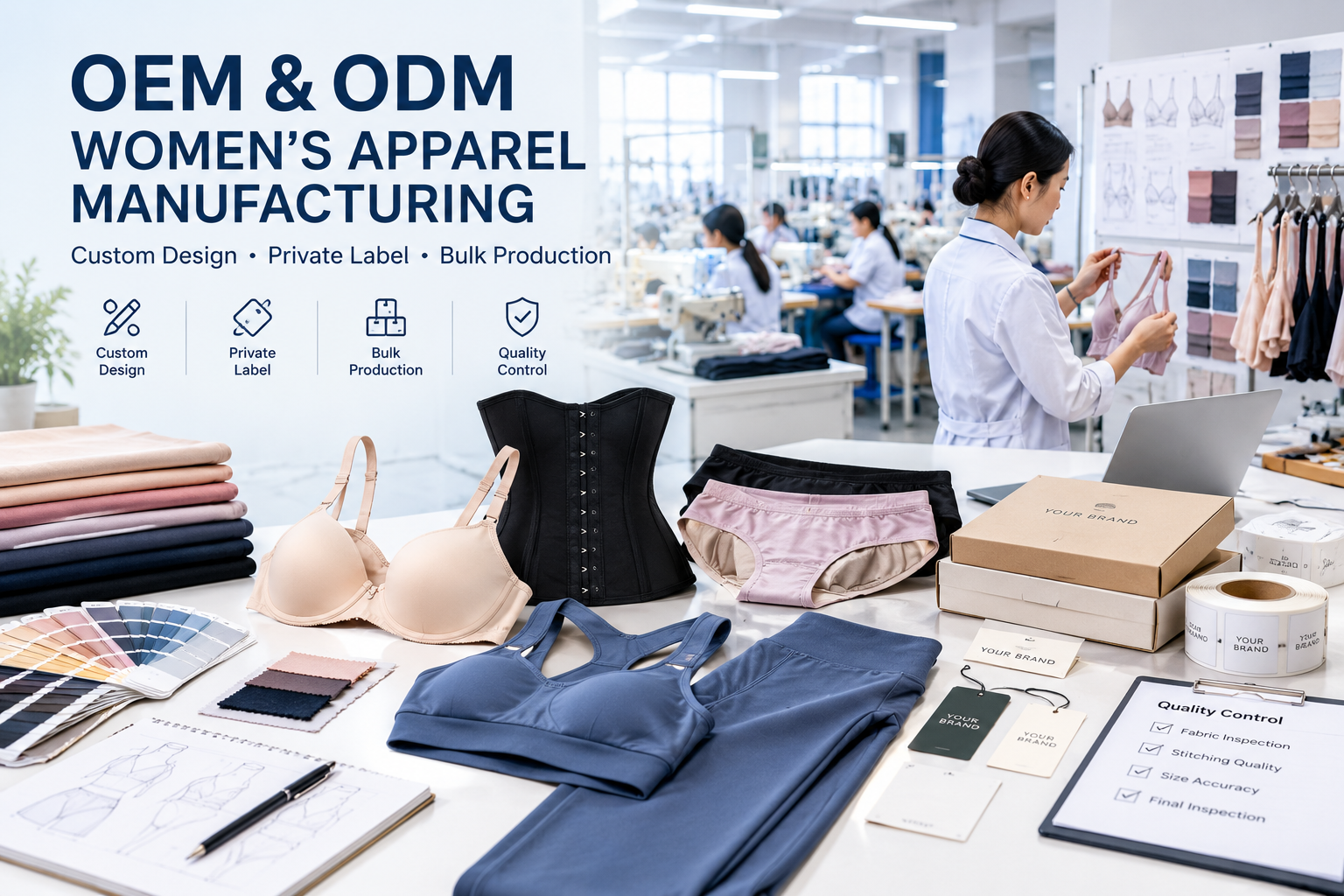
As demand for period panties scaled globally, the manufacturing ecosystem supporting the category grew with it. In China — already the world’s dominant textile and intimate apparel manufacturing hub — specialist factories began developing genuine expertise in period underwear production, moving well beyond the basic constructions of the early years.
Today, factories like Jingzhihe in Puning, China, manufacture period panties to sophisticated technical specifications for brands across North America, Europe, Australia, and beyond. Multi-layer construction techniques have been refined. Absorbency testing protocols have been standardised. Sustainable material supply chains — including organic cotton and bamboo certifications — have been developed. The manufacturing quality available to period underwear brands today is dramatically superior to what was possible even five years ago.
The global period underwear market is now estimated to be worth several hundred million dollars annually, with growth projections showing continued strong expansion through the rest of the decade.
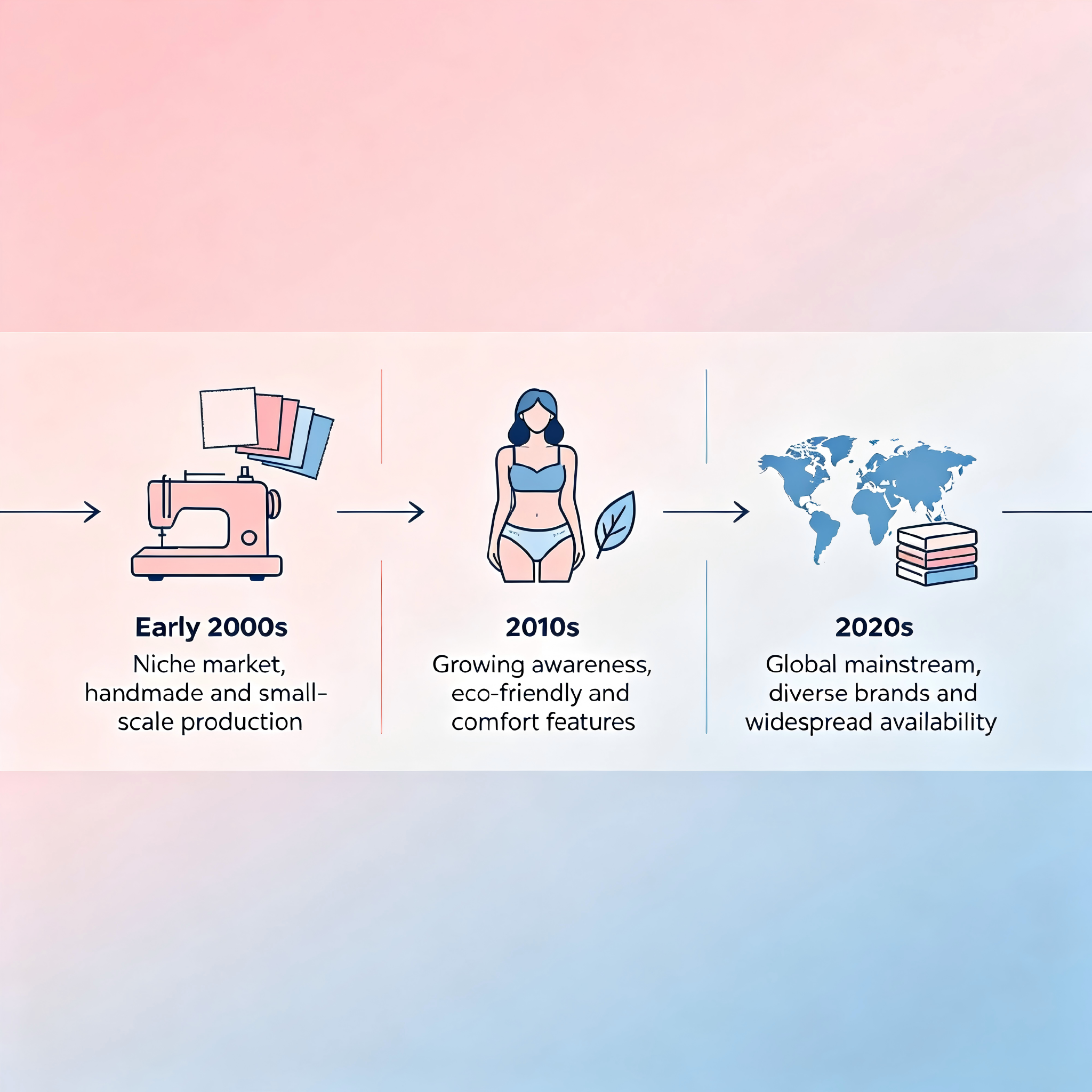
Complete History of Period Panties: Timeline at a Glance
Pre-2000s | Rubber and padded underwear | Early versions were heavy, uncomfortable, and designed only for extreme leak backup — far from modern period panties |
2004–2008 | First modern prototypes emerge | Small innovators began experimenting with multi-layer absorbent underwear; products remained niche and little-known |
2011–2013 | Brand pioneers enter the market | Early DTC brands in the US and Australia launch the first commercially available modern period underwear lines |
2014–2015 | Crowdfunding validates demand | Successful Kickstarter and Indiegogo campaigns prove significant consumer appetite for period underwear alternatives |
2015–2017 | Mainstream media attention | Major publications cover period panties; consumer awareness grows rapidly in North America and Europe |
2018–2019 | Retail expansion | Period underwear reaches mainstream retail; major department stores and e-commerce platforms begin stocking the category |
2020–2021 | COVID-19 accelerates sustainability shift | Pandemic drives surge in sustainable product adoption; period panties sales grow significantly as disposable supply chains are disrupted |
2022–2023 | Global market reaches $300M+ | The category achieves significant scale; dozens of brands compete; manufacturing sophistication increases globally |
2024–2025 | China manufacturing scales to meet demand | Specialist China factories including Jingzhihe provide OEM/ODM manufacturing for global brands at scale; product quality reaches new standards |
Now | Mainstream menstrual health product | Period panties are now a mainstream choice; sold in pharmacies, supermarkets, and online globally; adoption continues to grow |
What the History of Period Panties Tells Us About the Future
The history of period panties is a story of accelerating change. A product that barely existed twenty years ago is now a mainstream consumer choice in dozens of markets worldwide — and adoption continues to grow. Several trends suggest that the strongest growth chapters are still ahead:
Generational shift: Younger consumers — particularly Gen Z — are significantly more likely to use reusable menstrual products than older generations. As this cohort ages into peak purchasing power, period panties adoption will continue to rise.
Sustainability regulation: Growing legislative pressure on single-use plastic in Europe and other markets is increasing the regulatory tailwind behind reusable menstrual products.
Market expansion: Penetration in developing markets — including South America, Southeast Asia, and Africa — remains very low. As awareness and purchasing power grow in these markets, the global addressable market for period panties will expand significantly.
Manufacturing innovation: Continued improvements in functional fabrics, sustainable materials, and production efficiency will make period panties more accessible at lower price points, broadening adoption across income segments.
Jingzhihe: Part of the Period Panties Story
As a specialist period underwear factory in China, Jingzhihe is part of the manufacturing infrastructure that has made the global period panties market possible. We manufacture for brands across the world — helping them bring quality, certified, high-performance period underwear to their customers at every stage of the market’s continuing growth.
Whether you are launching your first period underwear collection or scaling an established brand, Jingzhihe has the expertise, production capacity, and commitment to quality to support your next chapter in this ongoing story.
Contact Jingzhihe today: