Introduction: Why Selling Period Panties Online Is One of the Best Brand Opportunities Right Now
Learning how to sell period panties online is one of the most commercially attractive brand-building opportunities in the personal care and intimate apparel space. The global period underwear market continues to grow rapidly — driven by sustainability trends, increasing menstrual health awareness, and a generational shift toward reusable products. Online channels, where consumer discovery and education happen simultaneously, are the natural home for period panties marketing.
This guide is a complete market entry framework for entrepreneurs, brand owners, and wholesale buyers who want to sell period panties online — whether through a DTC website, Amazon, TikTok Shop, or a combination of channels. We cover everything from understanding the market and sourcing your product, to launching, marketing, and scaling your online period panties business.
Step 1: Understand the Market Before You Enter It
Who Buys Period Panties Online?
The primary online buyer of period panties is typically female, aged 18 to 45, with above-average interest in sustainability, health, and wellness. She actively researches purchases, reads reviews carefully, and is highly responsive to authentic brand storytelling. She is more likely to buy from a brand she trusts than from a marketplace commodity listing — which means brand investment has unusually high returns in this category.
Secondary segments include parents buying for teenagers, gift buyers purchasing for friends or family members who might not yet have tried period panties, and people with specific conditions such as endometriosis, fibroids, or PCOS who have urgent, high-volume protection needs.
What Drives the Purchase Decision?
Research consistently shows that first-time period panties buyers are primarily motivated by:
Environmental concern — wanting to reduce disposable menstrual product waste.
Curiosity and openness — willing to try a better solution if it is credibly presented.
Specific pain points — leaking at night, discomfort with conventional products, or skin sensitivity.
Social proof — a recommendation from a friend, influencer, or trusted content creator is the highest-converting acquisition source for most period panties brands.
Understanding these motivations informs every element of your online marketing strategy — from the channels you prioritise to the messaging you use and the social proof you build.
Step 2: Source the Right Product
Before you can sell period panties online, you need a product worth selling. Sourcing decisions made early in the process have long-lasting consequences for brand quality, customer satisfaction, and business profitability. The key sourcing principles for online period panties brands are:
Source from a specialist manufacturer, not a general garment factory. Period panties require technical multi-layer construction expertise that general apparel factories typically lack.
Require documented absorbency testing and waterproof performance testing before placing a bulk order. Vague performance claims will lead to customer disappointment and returns.
Request OEKO-TEX certified materials. Online consumers in the period panties category are highly aware of certification, and OEKO-TEX provides the third-party validation that builds trust.
Order a trial batch before committing to large inventory. Even with approved samples, a real-world trial batch validates production consistency before you invest in scale.
Choose a manufacturer that provides complete product specification documentation — absorbency data, material specs, certifications — because you will need this information to write compelling, accurate product listings.
Step 3: Choose Your Online Sales Channels
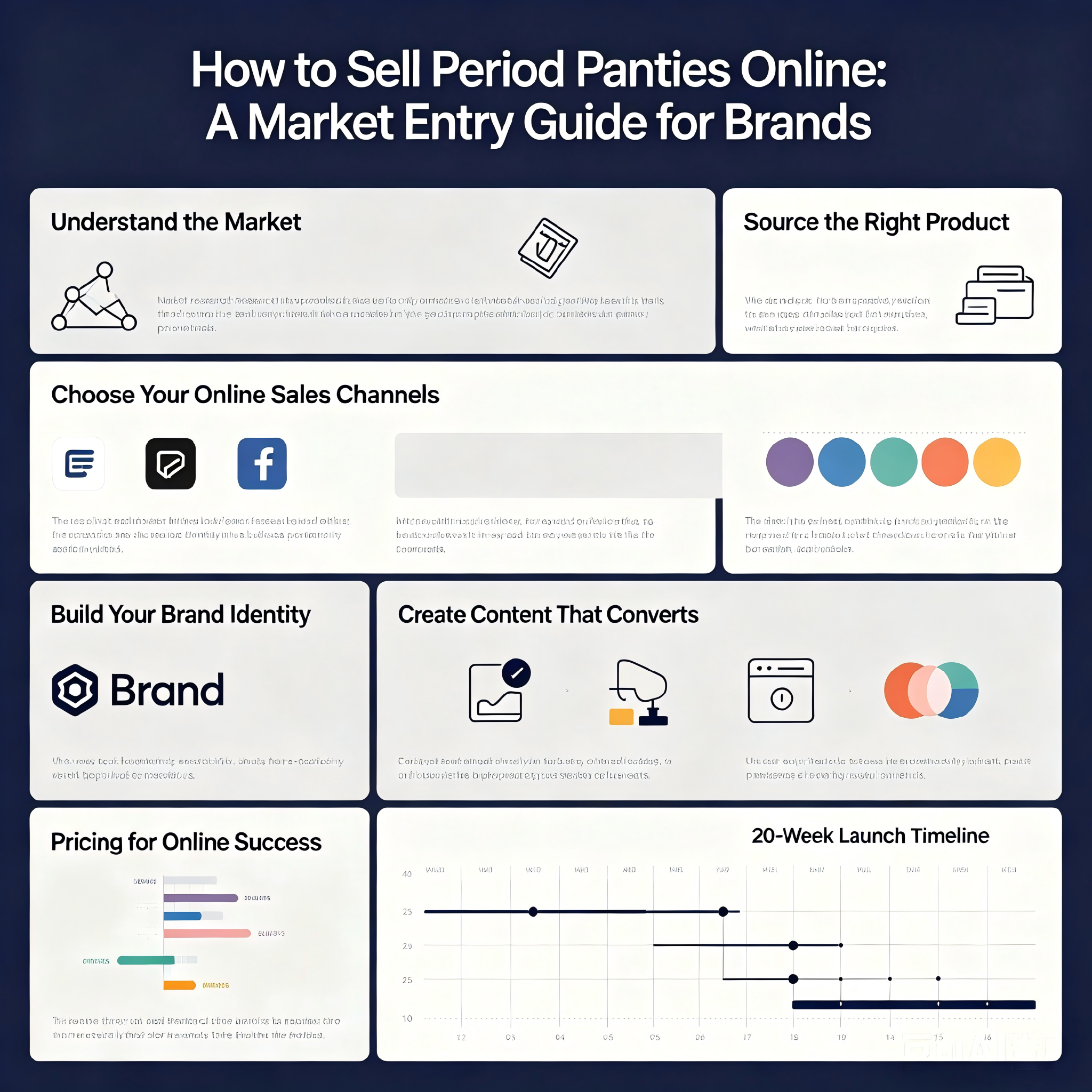
There is no single right answer to which online channel to sell period panties through. The best channel mix depends on your brand positioning, budget, audience, and operational capabilities. Here is a comprehensive comparison:
Own DTC website (Shopify / WooCommerce) | Highest (70–80% gross) | Full brand control; maximum margin; own customer data; no listing fees | High customer acquisition cost; requires SEO and paid traffic investment |
Amazon | Moderate (45–60% gross) | Massive existing traffic; fast launch; trusted checkout; FBA fulfilment option | High competition; listing fees; limited brand differentiation; algorithm dependence |
Etsy | Moderate (50–65% gross) | Eco/handmade audience; lower competition than Amazon; community trust | Smaller scale; not suitable for high-volume wholesale brands |
TikTok Shop | Variable (40–65% gross) | Viral growth potential; creator-driven discovery; young demographic | Requires video content investment; algorithm-driven; unpredictable |
Wholesale to retailers | Lower (30–45% gross) | Larger orders; reduced marketing burden; brand credibility via retail presence | Lower margins; longer payment cycles; retail packaging requirements |
Subscription / bundle | High (65–75% gross) | Predictable revenue; high customer lifetime value; reduced churn | Requires logistics and subscription management infrastructure |
Most successful period panties brands use a multi-channel strategy: a DTC website as the primary brand home, supplemented by marketplace presence for discovery traffic, and social commerce (TikTok, Instagram) for community building and viral growth. Starting with one primary channel and adding others as operations stabilise is the recommended approach for new entrants.
Step 4: Build Your Brand Identity and Product Positioning
Period panties is a crowded and growing market. A generic “eco-friendly period underwear” positioning will not cut through. Successful online period panties brands have a specific, ownable point of view that makes them memorable and shareable.
Positioning Frameworks That Work
Consumer segment specialisation: “The period panties brand built for heavy flow” or “Period underwear designed for active women.” Specificity beats generality in a crowded market.
Values-led positioning: “Zero waste. Zero compromise.” or “Period care as radical self-care.” Resonates deeply with Gen Z and millennial consumers.
Quality-led positioning: “The period panties that actually work.” For consumers burned by underperforming products, a bold quality promise backed by real product evidence is compelling.
Inclusivity positioning: “Period panties for every body, every flow.” Inclusive sizing and flow-level coverage builds community and word-of-mouth.
Your positioning should inform your brand name, visual identity, tone of voice, and every product listing you write. Consistency across all touchpoints builds the brand recognition that drives organic growth over time.
Step 5: Create Content That Converts
Content is disproportionately important in the period panties category because most buyers need education before they are ready to purchase. Unlike a commodity product where the purchase decision is immediate, period panties require the buyer to understand how the product works, believe the performance claims, and feel confident in the brand before clicking add to cart.
Content Types That Drive Period Panties Sales
How-it-works explainer content: Short videos or illustrated guides showing the multi-layer construction and how absorbency and waterproofing work together. Addresses the most common pre-purchase question.
Honest absorbency demonstrations: Showing — not just claiming — how the product absorbs liquid builds trust more effectively than any marketing copy.
Real customer reviews: Video testimonials and detailed written reviews from real customers are the highest-converting content for first-time buyers.
Care and use guides: Content that shows how easy period panties are to use, wash, and maintain reduces the practical objections that prevent purchase.
Comparison content: Side-by-side comparisons with disposable products (cost, environmental impact, comfort) are highly shareable and effective at converting consideration into purchase.
Step 6: Pricing for Online Success
Pricing period panties for online sale requires balancing competitive positioning with sustainable margin. The most important principle is that period panties should not be priced as a budget product. The category’s value proposition is built on premium performance and long-term value — and a price point that feels too low signals quality concerns rather than value.
For most markets, a DTC retail price of $20 to $45 per pair for mid-range products, and $30 to $55 for premium or specialist styles, is consistent with successful brand positioning. Below $18 to $20 retail, consumer trust in product quality begins to erode. At these price points, a well-sourced product from a quality China manufacturer like Jingzhihe delivers healthy gross margins — typically 65 to 80 percent on landed cost for DTC.
Step 7: Your 20-Week Launch Timeline
Here is a practical week-by-week timeline for taking a period panties brand from concept to live online sales:
1–2 | Research & brief | Define target consumer, brand positioning, pricing strategy; contact factory; request samples | Approved factory partner; product brief confirmed |
3–5 | Sample development | Review and test factory samples; assess absorbency, waterproofing, sizing, construction quality | Approved pre-production sample |
6–7 | Brand and packaging | Finalise brand identity, label artwork, packaging design; submit artwork to factory for approval | Approved brand assets and packaging artwork |
8–10 | Bulk production | Place bulk order; monitor production milestones; conduct quality inspection before shipment | Bulk order produced and shipped |
11–13 | Channel setup | Build website / marketplace listings; write product descriptions; set up photography | Live product listings ready for launch |
14–16 | Pre-launch marketing | Build social media presence; seed product with micro-influencers; build email waitlist | Audience and awareness built pre-launch |
Week 16 | Launch | Go live on all channels; activate paid and organic traffic; monitor sales and reviews | First sales; customer feedback loop opens |
17–20 | Optimise and scale | Analyse conversion data; adjust pricing/copy; plan reorder; identify top-performing channels | Profitable channel mix; reorder placed |
Common Mistakes When Selling Period Panties Online
Launching with too many SKUs: Start with three to four core styles. Complexity before market validation is a costly mistake.
Underinvesting in product photography: In period panties, lifestyle photography shows the product in realistic wear situations — not just flat lays — dramatically outperforms generic product shots.
Ignoring SEO from day one: Period panties is a high-search-volume category. Building SEO content — including buying guides, absorbency explainers, and comparison articles — from launch builds organic traffic that compounds over time.
Not collecting customer emails: Email marketing consistently delivers the highest ROI in direct-to-consumer e-commerce. Collecting emails pre-launch and building a waitlist before you go live dramatically improves launch-day sales.
Choosing the cheapest supplier: Product quality failures — leaks, premature wear, skin reactions — generate returns, negative reviews, and brand damage that far outweigh any unit cost saving from low-quality sourcing.
Launch Your Period Panties Brand with Jingzhihe
Jingzhihe is the manufacturing partner behind successful period panties brands selling across North America, Europe, Australia, and beyond. We provide specialist period underwear manufacturing with full OEM and ODM services, low MOQ for new entrants, OEKO-TEX certified materials, documented performance testing, and complete private label support — everything you need to launch a period panties brand online with confidence.
Whether you are building a DTC brand from scratch, adding period panties to an existing product range, or scaling a wholesale business, our team is ready to support your market entry from first sample to full-scale production.
Contact Jingzhihe today:
We look forward to helping you build a period panties brand worth buying — and worth selling.