Introduction: Why Period Panties Product Descriptions Are Different
Writing a period panties product description that actually sells is harder than it looks — and most brands get it wrong. Period underwear is a uniquely challenging product to describe because it sits at the intersection of intimate apparel, functional performance, health, and sustainability. Consumers have real anxieties about the product (will it leak? will it smell? will it feel uncomfortable?), and a product description that fails to address those anxieties directly will lose the sale — no matter how good the product actually is.
In this guide, we break down exactly how to write a period panties product description that converts browsers into buyers. We cover the copy framework that works, the specific language that builds trust, the technical details that matter, and the mistakes that kill conversions. Whether you are writing for your own DTC website, an Amazon listing, a wholesale catalog, or a retail product page, the principles in this guide apply.
The Fundamental Rule: Address the Fear Before You Sell the Feature
The most important principle in writing an effective period panties product description is this: your customer’s primary emotion when reading it is anxiety, not excitement. They want to know whether this product will embarrass them. Will it leak? Will it smell? Will they be able to feel it through their clothes? Will it be uncomfortable after three hours?
Every word in your period panties product description should work toward resolving those anxieties — directly, specifically, and confidently. Vague reassurances like “comfortable and effective” do nothing to address real fears. Specific, confident claims like “holds the equivalent of four regular tampons without any feeling of dampness” do. The shift from generic to specific is the single most powerful improvement most brands can make to their period panties product descriptions.
The Six-Part Copy Framework for Period Panties
A period panties product description that consistently converts follows a six-part structure. Each part does a specific job — and the order matters:
Hook | Opens with the consumer’s problem or desire | “Tired of waking up to leaks on your heaviest nights?” |
Product claim | States what the product does — concisely and confidently | “Our overnight period panties hold up to 5 tampons’ worth — all night, every night.” |
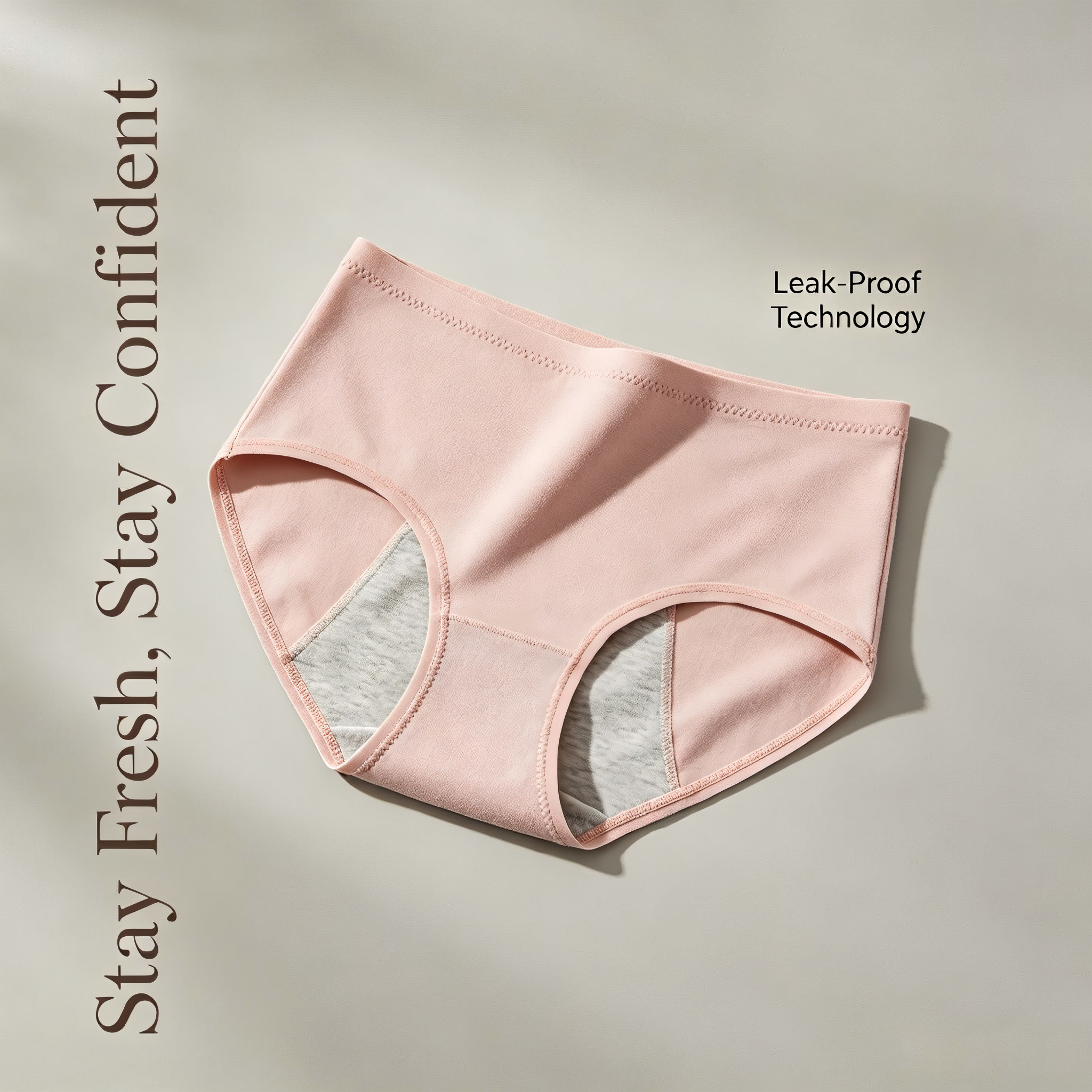
How it works | Briefly explains the technology to build trust | “Four-layer construction: moisture-wicking bamboo, absorbent core, TPU barrier, and soft outer fabric.” |
Key benefits | Lists 3–5 specific benefits in consumer language | “Stays dry. No shifting. No leaks. No smell. No chemicals.” |
Proof/trust | Adds certification, testing, or social proof | “Made from OEKO-TEX certified organic cotton — tested and free from harmful substances.” |
Call to action | Directs the next step clearly | “Choose your absorbency and find your perfect fit →” |
How to Write Each Section: Detailed Guidance
Part 1: The Hook — Open With the Problem, Not the Product
Most period panties product descriptions open with a description of the product. The most effective ones open with the customer’s problem. A hook that acknowledges the reader’s experience immediately creates an emotional connection that a product-first opening cannot.
Strong hooks for different consumer situations:
For heavy flow: “Your heaviest day deserves real protection — not another pad that shifts by lunchtime.”
For overnight use: “Wake up to clean sheets, not the stress of a midnight leak.”
For first-time buyers: “Imagine your period feeling completely normal. No fussing. No checking. Just comfort.”
For eco-conscious buyers: “Every pair replaces hundreds of disposables. Your period just got better for the planet.”
Choose a hook that matches the primary consumer motivation for the specific product you are describing. A heavy absorbency overnight style needs a different hook than a light everyday pair.
Part 2: The Product Claim — Be Specific and Confident
After the hook, state clearly and confidently what the product does. Avoid hedging language. “Our period panties are designed to provide reliable protection” is weak. “Our overnight period panties hold up to 20ml — equivalent to five regular tampons — through eight hours of sleep” is strong.
The product claim should answer the most important anxiety question your target consumer has about this specific product. For an overnight style, that is: will it last all night? For a sports style, it is: will it stay in place? For a light everyday style, it is: will anyone be able to tell I’m wearing period protection?
Part 3: How It Works — Brief, Specific Technology Explanation
A brief explanation of the multi-layer technology in period panties builds trust by demonstrating that the performance claim is based on real engineering — not marketing hope. Keep this section concise: two to three sentences is usually enough.
Effective technology descriptions name the layers and their functions:
“A moisture-wicking organic cotton inner layer keeps skin dry.”
“The absorbent core captures and locks in up to [X]ml of fluid.”
“A thin TPU waterproof barrier prevents any leakage to the outer fabric.”
Naming the TPU barrier specifically — rather than just calling it a waterproof layer — builds additional credibility by demonstrating materials knowledge. Consumers who research period panties will recognise TPU as the industry standard; those who do not will still benefit from the confidence that specific technical language conveys.
Part 4: Key Benefits — Consumer Language, Not Spec Language
Benefits are not features. Features describe what the product has; benefits describe what the product does for the consumer. Period panties product descriptions that list features lose to descriptions that articulate benefits.
Feature: “Four-layer gusset construction.” — So what?
Benefit: “Stays dry and leak-free through your entire school day or workday.” — Now the consumer can picture themselves in it.
Keep the benefits section tight — three to five bullet points is ideal for most product page formats. Lead with the most important benefit for your target consumer and make each benefit specific and concrete.
Part 5: Proof and Trust Elements
Period panties are a considered purchase — particularly for first-time buyers. Trust elements in the product description help reduce purchase hesitation. The most effective trust elements for period panties include:
Certification claims: “Made from OEKO-TEX Standard 100 certified organic cotton — independently tested and verified free from harmful substances.”
Specific test data: “Tested to hold up to [X]ml before any leakage — independently verified absorbency, not a manufacturer estimate.”
Care guarantee: “Designed to maintain full performance for 50+ washes with proper care.”
Social proof (if available): “Over [X] customers have made the switch.” or “4.8 stars from [X] verified reviews.”
Part 6: The Call to Action — Direct and Size-Focused
Most period panties product pages end without a clear call to action — they simply show the add-to-cart button and hope for the best. An effective CTA that acknowledges the size or absorbency decision increases conversion by reducing decision friction:
“Find your size using our fit guide and choose your absorbency below →”
“Not sure which absorbency is right for you? Take our 30-second flow quiz →”
“Your period, your protection. Choose your style and absorbency →”
Words That Convert vs Words That Undermine Trust
Word choice in period panties product descriptions has a significant impact on conversion. Here is a direct comparison of high-converting language versus language that weakens consumer confidence:
✅ Words and Phrases That Convert | ❌ Words and Phrases That Undermine Trust |
Leak-proof protection | Should not leak (undermines confidence) |
Holds up to X tampons’ worth | Very absorbent (vague — give a number) |
OEKO-TEX certified — tested safe | Chemical-free (unverifiable claim) |
Stays dry all day | Feels dry (hedged — commit to it) |
Wear for up to 8 hours | Long-lasting (vague — give hours) |
Made from organic cotton | Natural materials (non-specific) |
No smell. No shifting. No leaks. | Comfortable and effective (generic) |
Rinse, wash, and wear again | Easy to care for (show, don’t tell) |
TPU waterproof barrier | Waterproof lining (name the technology) |
Available in XS–6XL | Multiple sizes available (give the range) |
Platform-Specific Considerations
DTC Website Product Pages
On your own website, you have the most space and the most control. Use the full six-part framework, and consider adding an expandable FAQ section below the main description that addresses specific consumer concerns (How do I wash them? What if they leak? How do I know which size?). A well-written FAQ section can dramatically increase conversion by resolving the final objections that prevent purchase.
Amazon and Marketplace Listings
Amazon product descriptions have specific structural requirements — title, bullet points, and A+ content. For period panties, your title should include the keyphrase, the style, the absorbency level, and a key material claim (e.g., “Period Panties — Heavy Flow Hipster — Organic Cotton — Leak-Proof — Sizes XS–4XL”). Your five bullet points should map directly to the five most important consumer concerns: absorbency, leak protection, comfort, materials safety, and washing ease.
Wholesale Catalog Descriptions
For wholesale buyers and retail buyers reviewing a catalog, the product description serves a different purpose. It needs to communicate the product’s consumer appeal and sales potential rather than persuading an end consumer to buy. Focus on the target consumer, the key performance claims, the materials and certifications, and the commercial positioning. Include the specific absorbency data that retailers need to accurately represent the product on their shelves.
A Worked Example: Before and After
Before (Generic — Low Converting)
“Our period panties are made from high-quality materials and offer reliable protection throughout your cycle. They are comfortable, reusable, and easy to care for. Available in multiple sizes and absorbency levels.”
After (Specific — High Converting)
“Heavy days deserve real protection. Our heavy-flow hipster holds up to 20ml — the equivalent of four regular tampons — for up to eight hours of leak-free wear. A moisture-wicking organic cotton inner layer keeps you dry, while our thin TPU waterproof barrier means nothing reaches the outer fabric. Made from OEKO-TEX certified fabrics — tested and verified free from harmful substances. Rinse, machine wash on gentle, air dry. Designed to perform for 50+ washes. Available in XS to 4XL — choose your size and absorbency below.”
The before version is 38 words of nothing. The after version is a conversion engine that addresses every key consumer anxiety with specific, confident claims. The length is almost the same — the difference is entirely in specificity and consumer focus.
How Jingzhihe Supports Your Product Description Strategy
Writing a great period panties product description requires knowing exactly what is in your product — the materials, the absorbency data, the certifications, and the construction details. At Jingzhihe, we provide all wholesale clients with complete product specification sheets, fabric test reports, absorbency test data, and certification documentation — giving you everything you need to write product descriptions that are not just compelling, but accurate and verifiable.
Because we know that a well-described, honestly represented product builds the kind of customer trust that drives repeat purchases and brand loyalty — and that starts with giving our clients the facts they need to tell their product’s story correctly.
Contact Jingzhihe today:
We look forward to helping you build a period panties brand with products worth writing about — and descriptions worth reading.