Introduction: Why Period Panties Quality Control Is Non-Negotiable
Period panties quality control is not a nice-to-have in wholesale sourcing — it is the foundation of every successful period underwear brand. Period panties are intimate, functional products that consumers rely on for hygiene and protection during one of the most physically sensitive times of their cycle. A product that fails — through leaking, inadequate absorbency, or material safety issues — does not just result in a return. It damages brand reputation, loses customer trust, and in the worst cases exposes brands to product liability claims.
For wholesale buyers sourcing period panties from China or any other manufacturing region, understanding what quality control looks like in a professional period panties factory is essential. This guide breaks down every stage of the quality control process that wholesale buyers should demand — and explains how Jingzhihe implements these standards across all of our production.
Why Period Panties Require Specialist Quality Control
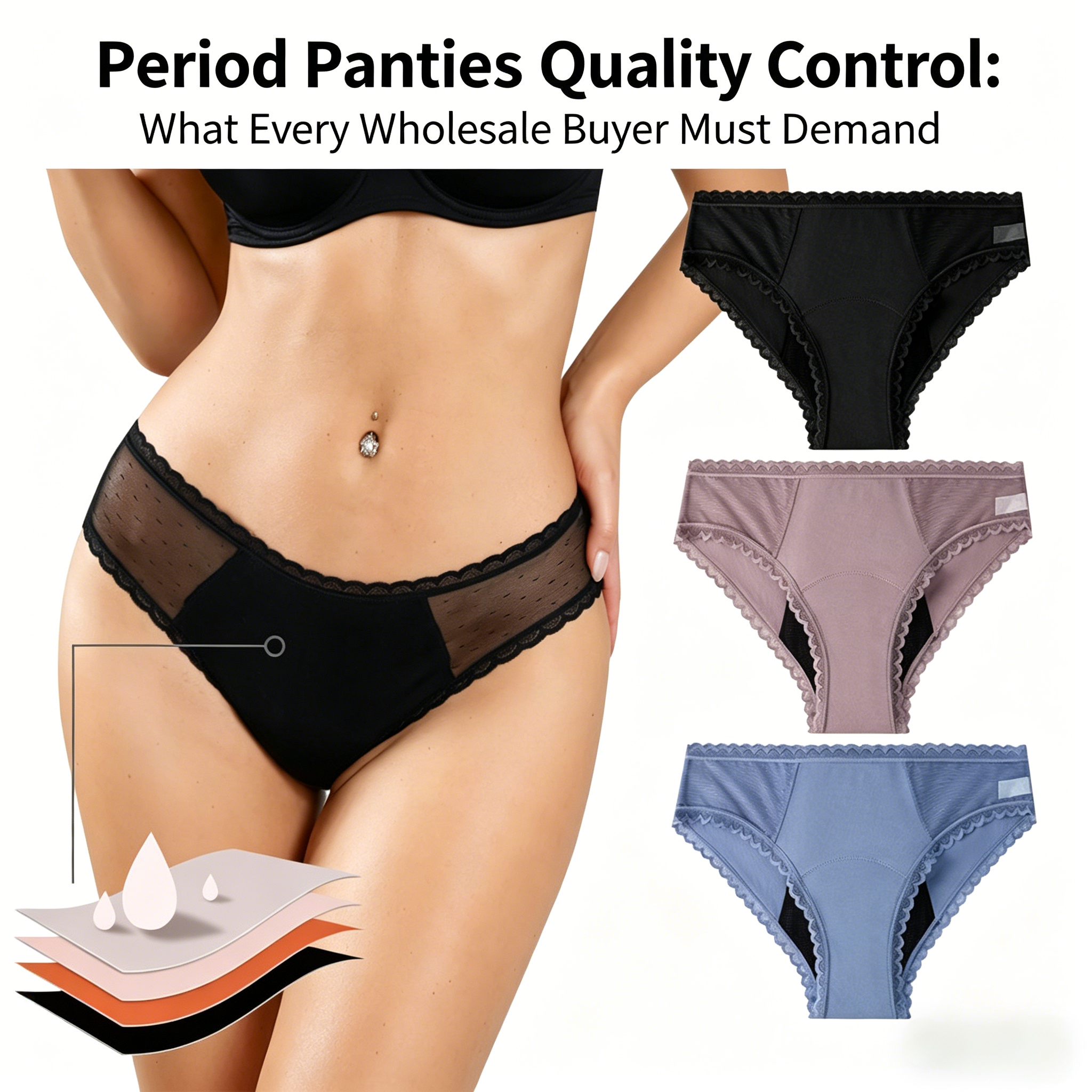
Period panties are technically more complex than regular underwear. Their multi-layer construction — inner comfort layer, absorbent core, waterproof barrier, and outer fabric — means that quality failures can occur at multiple points in the production process, and some failures are not visible to the eye.
A pair of period panties can look perfect but fail on absorbency performance if the core layer was incorrectly specified or constructed. It can appear flawless but leak if the TPU waterproof barrier was damaged during sewing or has delaminated from the core. These hidden quality failures only reveal themselves when the consumer uses the product — which is precisely the worst possible time for them to occur.
Effective period panties quality control therefore requires both visual inspection and functional performance testing — not just a visual check of finished garments. Wholesale buyers who accept visual inspection alone are accepting significant quality risk.
The 8 Essential Quality Control Stages for Period Panties
A professional period panties factory should implement quality control at eight distinct stages of the production process. Here is the complete breakdown:
1 | Incoming Fabric Inspection | Fabric weight, color fastness, shrinkage rate, OEKO-TEX cert verification, TPU integrity test | Prevents substandard materials entering production — cheaper to reject fabric than finished goods |
2 | Pre-Production Sample Approval | Construction, absorbency performance, waterproof test, sizing accuracy, label placement, packaging spec | Confirms bulk production will match the approved standard before any bulk cutting begins |
3 | In-Line Production Check | Stitch density, seam strength, gusset layer alignment, elastic tension, construction consistency | Catches defects while production is still in progress — far less costly than post-production corrections |
4 | Absorbency Performance Test | Measured volume of liquid applied to gusset; absorption rate and total capacity recorded against spec | Verifies the product delivers the stated absorbency level — core functional claim of the product |
5 | Waterproof Barrier Test | Pressure applied to outer fabric after gusset saturation; checks for any moisture transfer through TPU layer | Confirms the waterproof barrier is intact and functional — the most critical leak-prevention check |
6 | Dimensional Accuracy Check | Garment measured against approved size specifications at waist, hip, gusset length, and leg opening | Ensures consistent sizing across the production run — critical for retail returns and customer satisfaction |
7 | Final Visual Inspection | Stitch quality, seam evenness, label placement, hang tag attachment, packaging integrity, color consistency | Catches appearance and finishing defects before packing — protects brand presentation at point of sale |
8 | Wash Durability Test (sample) | Sample units washed 5–10 times; absorbency and waterproof function re-tested; shape retention assessed | Validates product performance over time — confirms the product will perform as claimed for the consumer |
Stage 1: Incoming Fabric Inspection — The First Line of Defence
Quality control begins before a single stitch is sewn. When fabric rolls and materials arrive at the factory, they must be inspected against the specifications agreed with the buyer before they are accepted into production. This incoming inspection is the most cost-effective quality gate in the entire process — it is far cheaper to reject a substandard fabric roll than to discover the problem in finished garments.
For period panties, incoming fabric inspection should include physical testing of the fabric weight, colour fastness under wash conditions, dimensional shrinkage when washed at the specified temperature, pilling resistance for outer fabrics, and — critically — verification of OEKO-TEX certifications and TPU material safety data sheets against the original documents provided with the order.
Stage 2: Pre-Production Sample Approval — The Quality Benchmark
The pre-production sample — also called the PP sample or golden sample — is the most important quality document in any wholesale period panties order. It is the physical embodiment of the agreed product standard, and it serves as the quality benchmark against which all bulk production is measured.
Before bulk production begins, the factory produces a small number of PP samples using the exact materials, construction methods, and branding specifications of the agreed product. The wholesale buyer — or their quality representative — reviews and approves these samples in detail. Once approved, the PP sample becomes the reference standard for the entire bulk production run.
Wholesale buyers should never approve a PP sample without conducting the following checks:
Absorbency test: Pour a measured volume of liquid onto the inner gusset surface and verify absorption speed and total capacity against the stated specification.
Waterproof test: Press firmly on the outer fabric after the absorbency test and confirm no moisture transfers through the TPU layer.
Construction inspection: Check every seam, stitch, elastic, and layer alignment against the approved specification.
Sizing accuracy: Measure the garment at every key point against the approved size chart.
Label and packaging verification: Confirm all labels, care instructions, hang tags, and packaging match the approved artwork exactly.
Stage 3: In-Line Production Inspection — Catching Problems Early
In-line quality control — conducted while bulk production is actively in progress — is one of the most valuable and most frequently skipped quality stages in period panties manufacturing. Many factories only inspect finished goods, by which point any construction defects have already been sewn into hundreds or thousands of garments.
In-line inspection involves quality control personnel walking the production floor at regular intervals to check that the work being done matches the approved PP sample standard. For period panties, in-line checks focus on stitch density and consistency, correct layer alignment in the gusset assembly, elastic tension at the waistband and leg openings, and seam placement relative to the approved pattern.
Wholesale buyers working with a factory for the first time should specifically ask about their in-line inspection frequency and documentation. A factory that cannot describe a documented in-line inspection process is a higher-risk partner for period panties production.
Stage 4 and 5: Performance Testing — The Non-Negotiable Functional Checks
Absorbency performance testing and waterproof barrier testing are the two most critical quality checks specific to period panties — and they are the checks that separate specialist period underwear manufacturers from general garment factories that claim to make period panties.
Absorbency Performance Testing
A documented absorbency test involves applying a precisely measured volume of liquid to the inner surface of the period panty gusset, recording the absorption speed and total capacity, and comparing the results against the stated product specification. The test should be conducted on multiple units from each production batch — not just a single sample — to verify consistency across the run.
Wholesale buyers should request written absorbency test reports for their product range, specifying the test methodology and the volume data for each absorbency level. A factory that cannot provide documented absorbency test data is not conducting genuine performance testing — and the absorbency claims on their products are unverified.
Waterproof Barrier Testing
After the absorbency test, the outer fabric of the period panty should be tested for moisture transfer. The test applies measured pressure to the outer fabric surface while the absorbent core is holding fluid — simulating the real-world conditions of a person sitting or moving while wearing the product. Any moisture transfer through the outer fabric indicates a failure of the TPU waterproof barrier.
TPU barrier failures can result from several causes: using substandard TPU film, damage to the TPU layer during sewing (particularly if the seam stitching pierces the barrier), delamination of the TPU from the absorbent core due to poor bonding, or simply using PVC or another non-TPU material as a low-cost substitute. All of these issues are detectable through proper waterproof testing — and none of them are visible to the naked eye in a finished garment.
Stage 6: Dimensional Accuracy — Protecting Your Brand’s Sizing Reputation
Inconsistent sizing is one of the most common and costly quality failures in period panties production — and one of the leading causes of retail returns. A period panty that runs significantly smaller or larger than the stated size creates a poor consumer experience, generates returns and negative reviews, and damages brand credibility.
Dimensional accuracy checks involve physically measuring finished garments at defined measurement points — waist circumference, hip circumference, gusset length, and leg opening — against the approved size specification. These checks should be conducted on multiple units across all size runs in the production batch to verify that the size grading has been applied consistently throughout production.
Stage 7: Final Visual Inspection — Protecting Brand Presentation
The final visual inspection before packing covers the appearance and finishing quality of every garment in the production batch. For period panties, this includes checking stitch quality and consistency across all seams, label placement and attachment security, hang tag positioning and branding accuracy, fabric surface quality including any pilling, snagging, or uneven dyeing, and packaging integrity and correct product-to-packaging matching.
Visual inspection should be conducted on 100% of units for small orders, and on a statistically significant sample for large bulk orders — typically following AQL (Acceptable Quality Level) sampling standards, which define acceptable defect rates for different order sizes and defect categories.
Stage 8: Wash Durability Testing — Validating Long-Term Performance
The final quality check that separates genuinely committed period panties manufacturers from those simply going through the motions is wash durability testing. This involves selecting representative units from the production batch, washing them five to ten times at the specified care temperature, and re-testing absorbency performance and waterproof integrity after each wash cycle.
Wash durability testing confirms that the product will maintain its stated performance over the realistic wash cycles a consumer would put it through — not just when it is brand new. A period panty that performs well on the first test but degrades rapidly after washing is a fundamentally inferior product, regardless of how well it photographs or how good the sample felt.
Red Flags: Quality Control Warning Signs to Watch For
When evaluating a period panties factory, these warning signs indicate inadequate quality control systems:
Cannot specify waterproofing material | No TPU — likely cheap PVC or no barrier at all | Request material spec sheet. If not provided, do not proceed |
No fabric certification documents | OEKO-TEX claims are unverified or false | Ask for certificate number and verify on OEKO-TEX website |
Refuses pre-production sample | Cannot replicate approved quality in bulk | Never order bulk without an approved PP sample. Walk away |
Vague absorbency claims | No actual testing done — absorbency is guesswork | Request a written absorbency test report with ml data |
Pricing far below market rate | Quality shortcuts on materials or construction | Investigate exactly where the cost saving is coming from |
Slow or inconsistent communication | Likely to cause production and delivery problems | Treat communication quality as a proxy for production quality |
How to Verify a Factory’s Quality Control Capability
Before placing a wholesale order, wholesale buyers should take these practical steps to verify a factory’s QC capability:
Request their documented QC procedures in writing — a professional factory will have written QC documentation, not just verbal descriptions.
Ask for a sample absorbency test report from a recent production run — this confirms they actually conduct performance testing.
Request fabric inspection records from recent incoming material checks.
Ask to observe the production and QC process, either in person or via a live video call walkthrough.
Commission a third-party inspection agency for the first large bulk order — independent inspection provides objective quality verification.
Start with a trial order and conduct your own performance tests on the received goods before committing to larger volume.
Quality Control at Jingzhihe: Our Commitment to Wholesale Buyers
At Jingzhihe, period panties quality control is embedded at every stage of our production process — from incoming fabric inspection to final pre-shipment checks. We conduct documented absorbency and waterproof testing on every product range we manufacture, and we provide test reports to wholesale clients on request.
Our quality control approach reflects a simple belief: a period panty only earns its place in a consumer’s rotation — and a brand’s catalog — when it delivers reliable, consistent performance every time it is worn. We build our products to meet that standard, and we back every shipment with the documentation to prove it.
Whether you are placing your first trial order or scaling up to large-volume production, our quality control systems protect your brand and your customers at every stage of the process.
Contact Jingzhihe today:
Website: https://ysssecret.com/
Email: susie@ysslingerie.com
Phone / WhatsApp: +86 13242263626
We look forward to demonstrating our quality control standards through product and process — not just promises.